
Part 2: How Google Gave AI to the World (2012-2024).
ChatGPT runs on Google research. So does Claude. So does Gemini. So does nearly every AI tool you've used in the past two years.
The technology powering the current AI revolution — the Transformer architecture — came from a Google research paper published in 2017. But Google didn't keep it proprietary. They published it openly, shared the code, and let competitors build on it.
This wasn't an accident. It was strategy.
Here are seven research breakthroughs that show how Google didn't just build AI for themselves — they gave the foundational tools to the world.
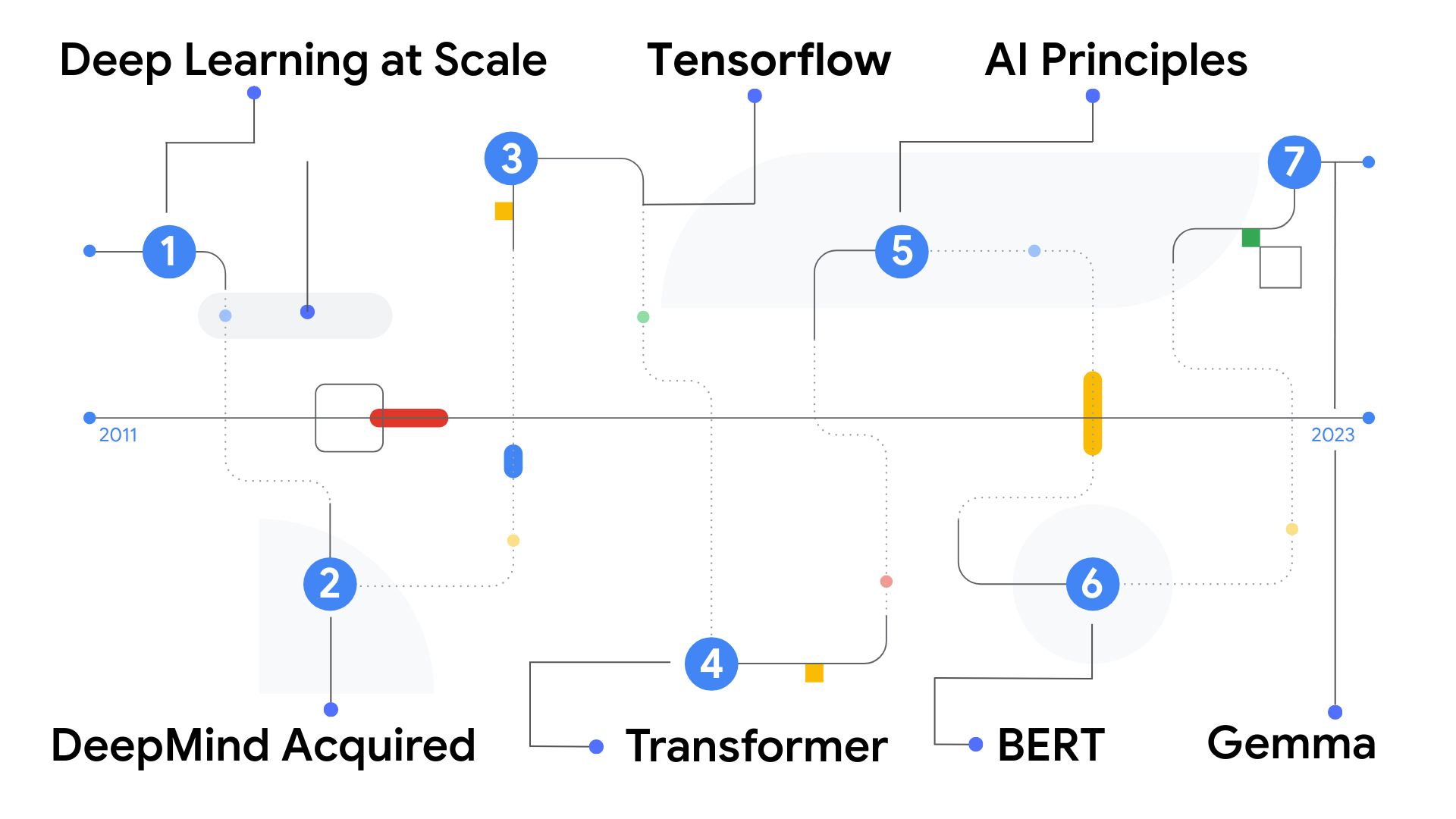
2012: The Year Deep Learning Proved Itself
The Cat Experiment: Unsupervised Learning at Scale. In 2012, the Google Brain team proved something remarkable: neural networks could learn without being told what to look for.
Their famous experiment involved showing a neural network 10 million YouTube video thumbnails. Without any labels or instructions, the system learned to recognize cats. Not because anyone told it what a cat looked like, but because the pattern appeared so frequently that the network identified it on its own.
This was unsupervised learning at scale. It demonstrated that with enough data and computing power, machines could discover patterns humans never explicitly programmed.
The implications were enormous. This wasn't just about cats, it was proof that deep learning could work on real-world, messy, unlabeled data.
Speech Recognition: Deep Learning Enters Production. That same year, deep learning made its first major leap into products people used daily. A landmark collaboration between four research groups, Google, Microsoft, IBM, and the University of Toronto, published research showing that deep neural networks dramatically outperformed the speech recognition systems that had dominated for over 30 years.
The previous standard, Gaussian Mixture Models (GMMs), had reached a plateau. Deep neural networks shattered it. In August 2012, Google announced that the new approach reduced error rates by over 20%. The same month, with the launch of Android Jelly Bean, neural network-based speech recognition went live in Google Voice Search.
Behind the scenes, LSTM (Long Short-Term Memory) neural networks had launched in Android's speech recognizer in May 2012, networks that could "remember" context from earlier in a sentence, dramatically improving accuracy. This wasn't a research demo, it was Google Voice Search getting measurably better for hundreds of millions of users.
Together, these 2012 breakthroughs proved deep learning's dual promise: it could discover patterns autonomously (the cat experiment), and it could immediately improve products at scale (speech recognition). The AI era had a new foundation.
2014: DeepMind Joins Google
When Google acquired DeepMind in 2014, they weren't buying a product. They were buying a vision.
DeepMind's mission was ambitious: solve intelligence, then use it to solve everything else. Their approach combined deep learning with reinforcement learning — systems that learn by trial and error, the way humans learn to walk or play games.
Two years later, DeepMind's AlphaGo defeated the world champion at Go — a game so complex that brute-force computing couldn't solve it. The system had to develop intuition.
This wasn't just a publicity stunt. It proved that AI could master domains requiring creativity and strategic thinking, not just pattern recognition.